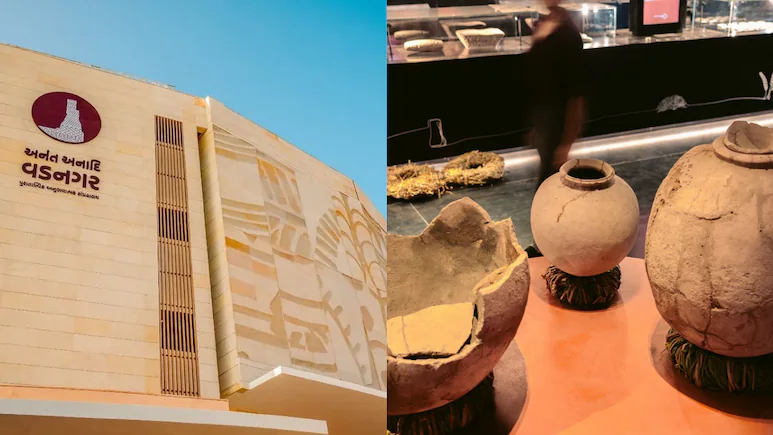
Gujarat’s Anant Anadi Vadnagar Archaeological Experiential Museum has earned international recognition after winning the Red Dot: Best of the Best Award 2026 in Germany. The distinction makes it the first museum in India to receive this particular honour, bringing global attention to a heritage project that combines archaeological discoveries with immersive exhibition design.
Located in Vadnagar in Gujarat’s Mehsana district, the museum offers visitors a journey through more than 2,500 years of the town’s history. Its galleries bring together over 6,000 archaeological artefacts, interactive displays and reconstructions, while a nearby excavation site allows visitors to explore the remains of earlier settlements.
What Makes the Vadnagar Museum Special?
The Anant Anadi Vadnagar Archaeological Experiential Museum is designed to present archaeology as an experience rather than simply a collection of objects behind glass.
Its exhibition design uses seven layers of rammed earth to represent different historical periods. These layers provide a visual connection to the successive cultural phases that shaped Vadnagar over centuries.
The project was designed by Noida-based Design Factory India for the Directorate of Archaeology and Museums, Government of Gujarat. The Red Dot recognition was awarded in the Brands and Communication Design 2026 programme, under the Exhibition Design category.
The museum’s collection includes pottery, coins, weapons, tools, sculptures, ornaments, beads and objects associated with traditional industries. Together, these objects offer insights into the region’s trade, craftsmanship, religious traditions and everyday life.
Vadnagar Has More Than 2,700 Years of History
Vadnagar is one of India’s oldest continuously inhabited fortified towns. Archaeological evidence traces human settlement in the town to around 750 BCE, with excavations revealing seven successive cultural periods.
Research conducted by the Archaeological Survey of India and the Gujarat government’s archaeology department uncovered remains of fortifications, residential structures, paved streets, industrial workshops and religious establishments.
Vadnagar’s history reflects the influence of several historical periods and communities, including Mauryan, Indo-Greek, Shaka-Kshatrapa, Maitraka, Solanki, Sultanate and Mughal phases, followed by later periods.
The archaeological evidence also points to the coexistence of Hindu, Buddhist and Jain traditions. Among the important discoveries are Buddhist monastic remains and structures associated with early religious activity.
The museum brings these different chapters together to explain how the town’s architecture, economy and cultural identity evolved over time.
Visitors Can Explore an Actual Excavation Site
One of the museum’s most distinctive features is its connection to the nearby Amba Ghat excavation site.
The site contains archaeological remains uncovered during excavations, offering visitors a closer look at the successive layers of habitation beneath modern Vadnagar. The exposed remains help demonstrate how settlements developed, changed and were rebuilt across different periods.
The excavated deposits extend deep below the present ground level, with archaeological layers reaching approximately 16–18 metres. A viewing walkway allows visitors to observe the remains and understand the relationship between different stages of the town’s history.
Inside the museum, the Excavation Gallery adds another dimension through scaled models, interactive displays and a 3D film that takes visitors through the archaeological layers.
This combination of physical remains and digital interpretation helps make the subject accessible to visitors who may not have a background in archaeology.
How to Plan a Visit to Vadnagar Museum
Vadnagar is located in Gujarat’s Mehsana district and can be reached by road and rail. It is approximately 110 km from Ahmedabad, making it a possible addition to a heritage-focused trip through northern Gujarat.
The museum’s official visitor information lists the following timings:
- Opening hours: 10 AM to 6 PM
- Last entry: 4:30 PM
- Weekly closure: Wednesday
- Other closures: Public holidays
The museum also provides facilities such as ramps, elevators and accessible restrooms. Visitors can check ticket availability and current entry arrangements through its official booking facility before travelling.
Beyond the museum, Vadnagar has other historical attractions, including the Kirti Toran and its old streets, which offer further glimpses of the town’s architectural and cultural heritage.
The Red Dot recognition adds a new dimension to Vadnagar’s growing heritage profile. By connecting archaeological research with contemporary museum design, Anant Anadi demonstrates how historical sites can be interpreted for modern audiences while retaining their connection to the past.