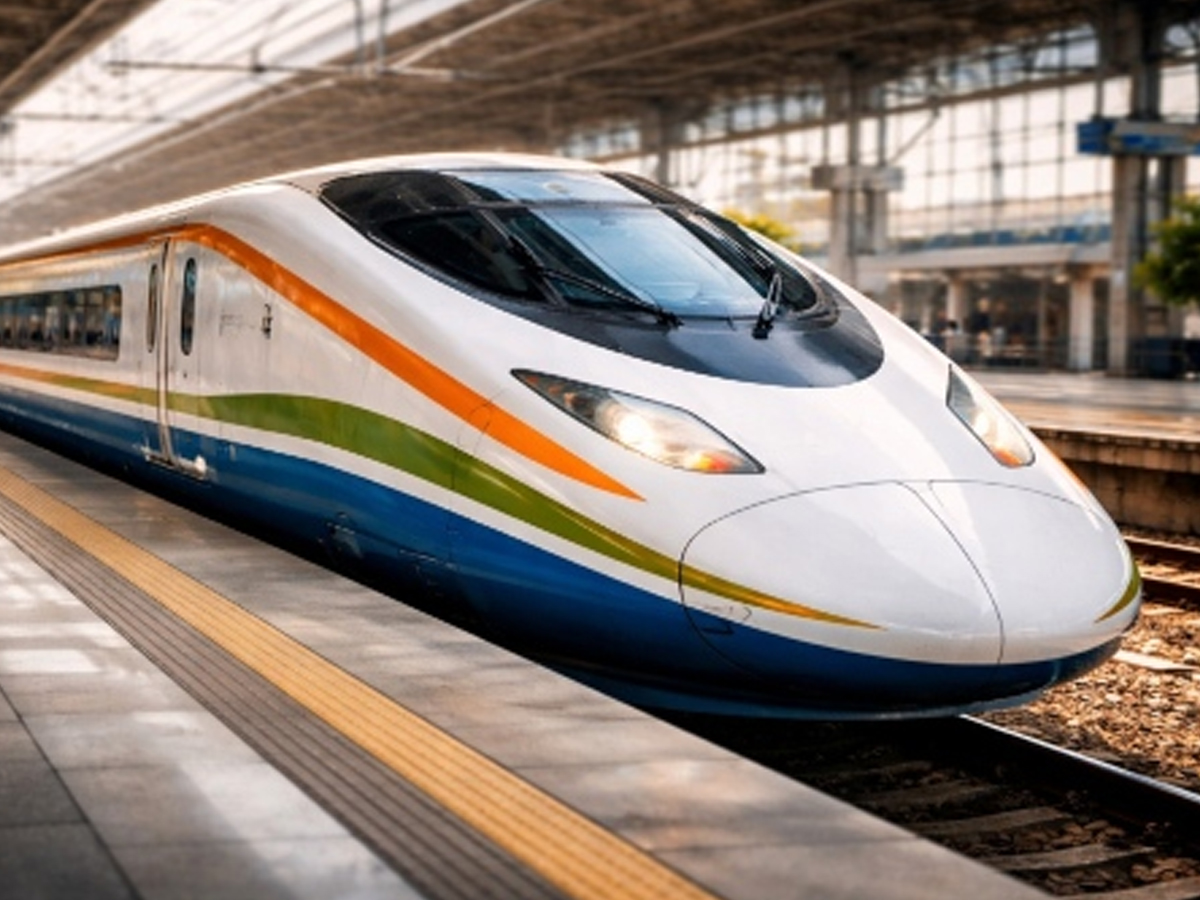
India is working on a new generation of indigenous high-speed trains as part of a broader effort to strengthen domestic railway technology. Among the projects under development is the B35, a proposed bullet train designed to reach speeds of up to 350 kmph.
The programme is aimed at developing high-speed train technology within India while reducing dependence on foreign systems. The development of indigenous trains is being pursued alongside the infrastructure and signalling capabilities required for high-speed rail operations.
India Targets Indigenous High-Speed Trains by 2030
The B35 forms part of India’s longer-term plan to develop its own high-speed train technology. The stated target is to have domestically developed bullet trains by around 2030.
The initiative comes as India continues work on the Mumbai-Ahmedabad High-Speed Rail (MAHSR) project, the country’s flagship high-speed rail corridor.
The Union Cabinet has approved a revised budget for the MAHSR project, taking its estimated cost above ₹2 lakh crore, according to the source material. Around ₹1 lakh crore is expected to be provided through the Union Budget.
Mumbai-Ahmedabad Corridor Covers 508 km
The MAHSR project covers approximately 508 km, connecting Maharashtra, Gujarat and the Union Territory of Dadra & Nagar Haveli.
The planned stations are:
- Mumbai
- Thane
- Virar
- Boisar
- Vapi
- Billimora
- Surat
- Bharuch
- Vadodara
- Anand
- Ahmedabad
- Sabarmati
The corridor is a central part of India’s high-speed rail programme and is being developed alongside efforts to build domestic train manufacturing and railway technology capabilities.
B28 and B35 Form Part of Wider Train Development
India is also developing the B28 high-speed train as part of its domestic railway technology programme.
According to the source material, work is taking place on both train development and signalling technology. The Bharat Train Control System (BTCS) is being developed as an Indian train control and signalling system.
BTCS is intended to help regulate train speeds and maintain safe distances between trains. The system is described in the source as having similarities to China’s CTCS, which is used for conventional as well as high-speed railway operations.
ICF and BEML Developing High-Speed Trainsets
The Integral Coach Factory (ICF) and Bharat Earth Movers Limited (BEML) are working together on the development and manufacture of new high-speed trainsets.
The trainsets currently being developed are designed for speeds of up to 280 kmph. This is separate from the B35’s stated target speed of 350 kmph.
The development of multiple train platforms reflects India’s ongoing efforts to build domestic expertise in high-speed rolling stock.
Japan’s E10 Developments Also Form Part of the Background
The development of India’s indigenous high-speed trains follows changes in Japan’s own bullet-train programme.
According to the source material, Japan announced in December 2024 that it would gradually move away from production of its existing E5 series trains. Its newer E10 series is expected to enter production around 2030 and become operational later.
Indian officials may consider the E10 once it becomes available, while domestic programmes such as the B28 and B35 continue to develop in parallel.
Building Domestic Railway Technology
India’s high-speed rail programme involves more than the development of faster trains. Trainsets, signalling and control systems are all important components of high-speed railway operations.
The B35, B28 and BTCS projects therefore form part of a wider effort to develop railway technology within the country.
The B35’s proposed 350 kmph capability would represent a significant step in India’s domestic high-speed train development, while the MAHSR project provides an important infrastructure component of the country’s broader high-speed rail programme.