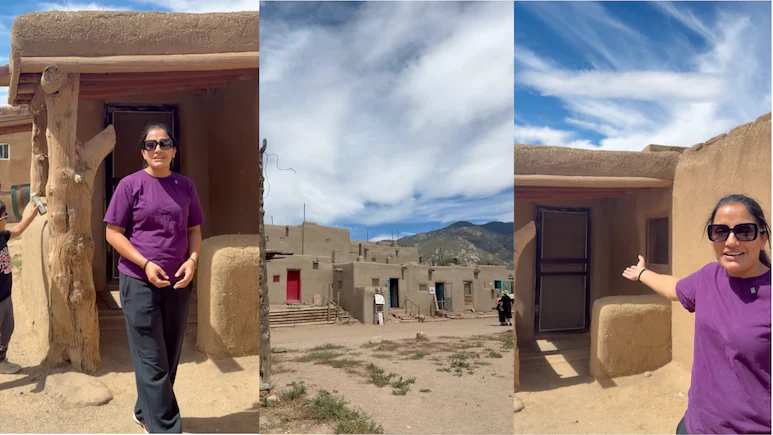
In northern New Mexico, Taos Pueblo offers visitors a glimpse into a way of life that has remained closely connected to its Indigenous heritage for centuries. The historic community is known for its distinctive adobe homes and its continued connection to traditional architecture, farming and cultural practices.
Unlike a typical modern American neighbourhood, many of the traditional homes at Taos Pueblo do not have electricity or running water inside. Residents continue to use traditional approaches while maintaining the character and heritage of the community.
A Living Community, Not a Museum
Travel content creator Sarika Yadav, who recently visited Taos Pueblo, described her first impression of the village as resembling a film set or an open-air museum. The reality, however, is quite different: the pueblo remains a living community.
Many of the traditional structures are built from adobe, a material made from earth and traditionally used across the region. Some buildings have multiple levels, with wooden ladders providing access between floors.
The village also includes shops, cafés and other facilities, creating a distinctive combination of everyday community life and historic architecture.
Traditional Living in Modern Times
One of the most notable features of Taos Pueblo is the absence of running water and electricity inside many of its traditional homes.
According to Yadav’s account, this is connected to the community’s desire to preserve its traditional lifestyle and architectural heritage rather than simply being a consequence of limited infrastructure.
The contrast between the historic adobe structures and the surrounding modern world is part of what makes Taos Pueblo distinctive for visitors.
A Community With Centuries of History
According to the official Taos Pueblo website, the community has lived and farmed in the Taos Valley since around 900 AD.
The pueblo’s famous adobe structures are believed to have been constructed between approximately 1000 and 1450 AD, making them an important part of the region’s Indigenous architectural heritage.
The community is also known as the Red Willow people or Pueblo people.
Taos Pueblo’s UNESCO Recognition
The cultural and historical importance of Taos Pueblo has earned it recognition as a UNESCO World Heritage Site.
The wider Taos Pueblo area covers approximately 99,000 acres, while the main village sits at an elevation of around 7,200 feet above sea level.
Today, approximately 75 people continue to live in the traditional homes, while other community members reside on surrounding lands.
Visiting Taos Pueblo
Taos Pueblo is also a destination for cultural tourism, allowing visitors to experience its architecture and learn about the community’s long history.
The site is generally open to visitors from 9 a.m. to 4 p.m., although access can change when important community ceremonies are taking place.
For travellers, a visit offers more than an opportunity to photograph historic adobe buildings. It provides a chance to encounter a living Indigenous community whose architecture, traditions and relationship with the land remain central to its identity.