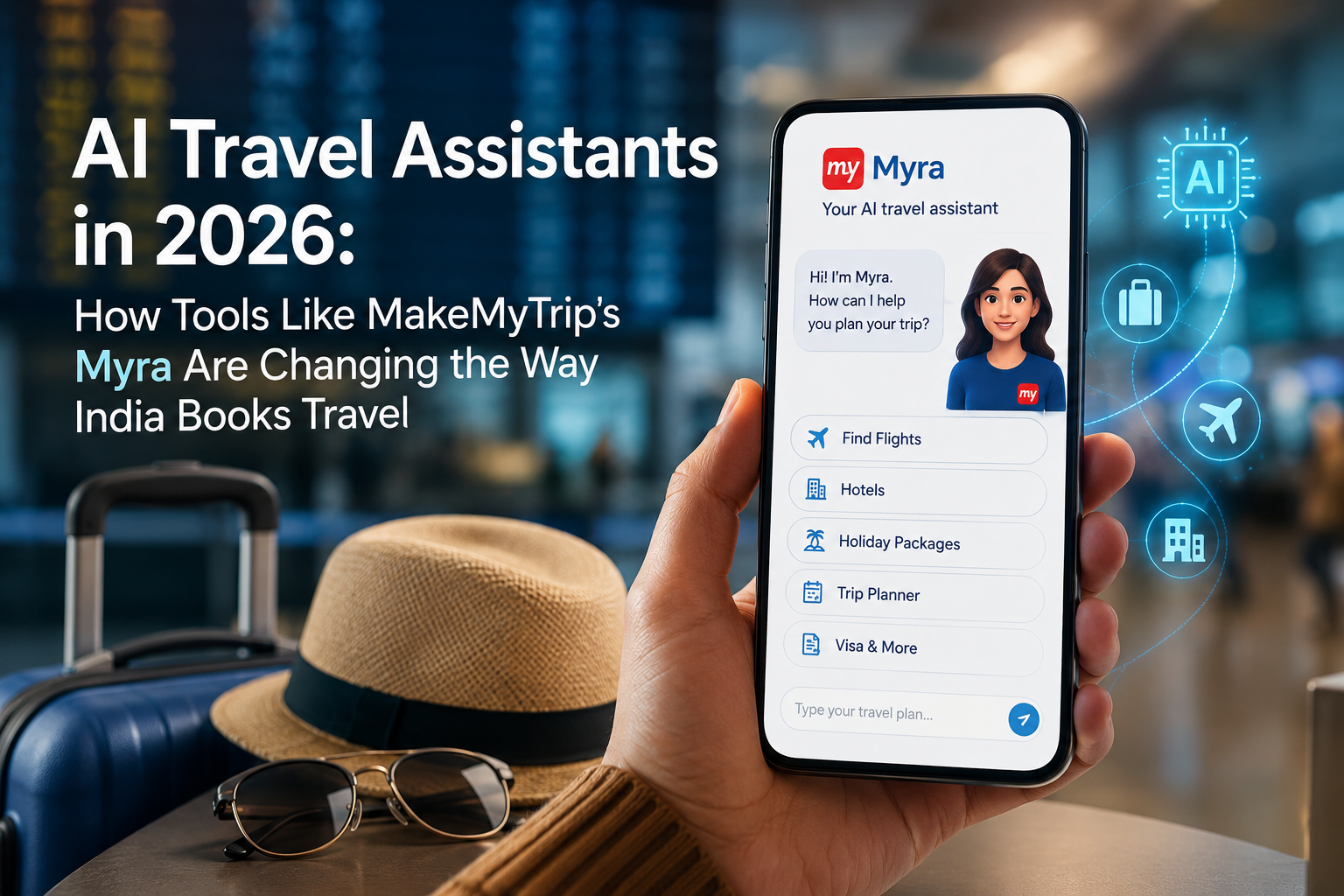
Not long ago, planning a holiday meant calling a travel agent, shuffling through half a dozen browser tabs, or spending an entire afternoon comparing prices across platforms. Today, a traveller can simply speak to a voice assistant in Hindi, Tamil, or Bengali, ask it to find a hotel in Varanasi with a vegetarian restaurant, wheelchair access, and connecting rooms for four, and receive a curated shortlist within seconds.
This is not a futuristic scenario being pitched at a technology conference. This is what MakeMyTrip’s Myra 2.0, launched in May 2026, already delivers. And it is one of the clearest signals yet of a shift that is quietly but decisively reshaping how Indians plan, research, and book their travels.
From Chatbot to Co-Pilot: What Has Changed
For much of the past decade, the travel industry’s version of artificial intelligence amounted to little more than rule-based chatbots dressed up in conversational clothing. Those early tools could field basic queries about baggage allowances and redirect users to a booking page, but they could not hold context, interpret layered preferences, or complete a transaction without the traveller managing each step manually.
The new generation of travel AI works differently in kind, not just in degree.
MakeMyTrip’s Myra 2.0, unveiled on 19 May 2026, represents perhaps the most complete articulation of where AI-assisted travel booking has arrived in India. The platform takes a traveller from an initial search all the way through to a confirmed, paid booking, entirely within a single conversational interface, and entirely by voice if desired. The system is designed to handle what Rajesh Magow, Co-Founder and Group CEO of MakeMyTrip, describes as the two hardest problems in travel technology.
“Travel sits at the intersection of real-time data, where prices and inventory changes are dynamic in nature, and high personal variance, where the same query can mean very different things depending on who is asking and why,” Magow said at the launch. “Myra is built to understand both layers, the live inventory and the human context, and to personalise basis both.”
The challenge in travel has never been a shortage of information. It has always been the gap between information and individual understanding. Myra’s architecture is designed to bridge that gap at scale, and the early numbers suggest it is doing so. The assistant is currently handling over 3 million conversations every quarter, and users who book through Myra complete their transactions at a 10 percent higher rate than those going through the conventional search-and-filter process. In a market as competitive as India’s online travel sector, that conversion lift carries significant strategic weight.
What Myra 2.0 Can Actually Do
Six new capabilities work in concert within Myra 2.0 to create an experience that is qualitatively different from earlier iterations.
The most prominent is end-to-end voice booking. Myra now supports complete voice-driven booking flows across eight languages: Hindi, Tamil, Telugu, Marathi, Bengali, Kannada, Malayalam, and English, with barge-in support that allows users to interrupt mid-sentence without losing context. A traveller in Patna can plan, select, confirm, and pay for a flight to Bangkok without ever touching the screen. The reach of this feature extends well beyond urban convenience. Over 45 percent of Myra’s conversations already originate from Tier-2 cities and smaller towns, where voice interaction in a native language is often the most accessible and natural mode of engaging with a digital platform. AI-powered booking in Indian regional languages is beginning to bring self-service travel planning to a segment of the population that the industry has long struggled to serve.
The second capability is agentic multi-step booking. Earlier booking interfaces required users to manually verify each step and restart searches whenever a constraint changed. Myra now maintains the full context of a booking conversation throughout its duration, handling complex itineraries without requiring the user to begin again. The platform cites the ability to process an international booking from Mumbai to São Paulo via Addis Ababa, including visa eligibility checks for an adult and a four-year-old child, as a benchmark of what the agentic layer can now complete conversationally.
Smarter autocomplete surfaces contextually relevant query completions as users begin typing, drawing on search history and seasonal patterns rather than generic keyword matching. Passport OCR and auto-fill removes one of the most friction-heavy moments in international booking: users photograph their passport, the system reads and populates the required details, and confirmation follows. Integrated payments close the final gap in the experience, processing the transaction within the conversation itself rather than redirecting users to a separate checkout screen. Multilingual contextual assistance goes beyond translation: a family planning a religious visit to Ayodhya carries different implied preferences from a solo traveller heading to Goa, and Myra is built to read that context rather than simply parse the words.
The Global Race to Rewire Travel Booking
What MakeMyTrip is building for India is being pursued, with different emphases and architectures, across the global travel industry.
Google has been the most consequential mover globally. Having piloted AI-powered trip planning through its Search AI Mode Labs experiment, the company is now integrating agentic booking capabilities directly into Search, working with Booking.com, Expedia, Marriott, and IHG Hotels and Resorts to allow travellers to research, compare, and complete bookings without leaving Google’s interface. Industry analysts widely expected Google to formalise these agentic travel booking tools at its I/O 2026 developer conference, a move that would fundamentally alter how travel inventory is discovered and how distribution economics flow across the industry.
Expedia has taken a different approach with its AI assistant Romie, embedding conversational planning tools inside the existing Expedia marketplace so that travellers receive AI-assisted discovery while transacting within a brand they already trust. Expedia Group processes roughly 1 billion travel searches a month, giving its AI layer one of the largest behavioural datasets in global travel to personalise from. At Explore 2026, the company positioned AI-powered itinerary builders, smart booking assistants, and predictive pricing as central competitive differentiators going forward.
Booking.com has pursued AI as a genuine trip-planning layer rather than a marketing surface, leaning into messaging-first integrations that reduce app friction for users. ChatGPT, through direct integrations with Booking.com, Expedia, Uber, and DoorDash, has introduced a new dynamic: general-purpose AI assistants functioning as a discovery channel that sits upstream of both OTAs and traditional search engines, potentially reshaping how travellers reach booking platforms in the first place.
Within India, ixigo’s AI assistant Tara has been positioned to compete directly for the same Tier-2 and Tier-3 traveller that Myra targets, establishing a genuine domestic contest whose outcome will have meaningful implications for the structure of India’s online travel market.
What It Means for the Indian Traveller
The most immediate beneficiary of this shift is the traveller, and in particular the traveller who has been historically underserved by existing booking infrastructure.
For the hundreds of millions of Indians whose primary internet device is a smartphone and whose most comfortable language is not English, AI travel assistants are reducing a barrier that the industry has struggled to address for years. A first-time international traveller in Lucknow who might previously have relied on a local agent, or found the complexity of self-service booking too daunting, can now navigate a Mumbai to Dubai booking entirely in Hindi, with visa guidance integrated into the same conversation. That represents a meaningful expansion of who participates in modern travel and at what level of confidence.
The scale of this shift is reflected in industry forecasts. AI trip planning tools are expected to be used by an estimated 68 percent of Indian travellers by the end of 2026. The broader Indian online travel market is forecast to reach $38.58 billion by 2031, growing at 8.74 percent annually. AI-assisted booking is positioned not merely to track that growth but to actively drive it by bringing new travellers into the self-service ecosystem.
For premium travellers, the value lies elsewhere. Complex itineraries involving multiple cities, bleisure combinations, or family travel with specific accessibility requirements have historically demanded specialist agent expertise or considerable personal effort. AI assistants that can hold the full complexity of such a trip in a single conversation, checking availability in real time throughout, offer a capability that no conventional search filter can match.
The Questions the Industry Is Grappling With
The enthusiasm around AI-assisted booking sits alongside a set of structural tensions that the travel industry has not yet fully resolved.
The distribution question is the most commercially significant. If an Indian traveller books a hotel in Bali through a conversation with Myra without ever encountering Booking.com’s listing, the implications for Booking.com’s marketing investment, ranking logic, and customer relationship are considerable. The same question extends to Google’s agentic ambitions. As one industry analysis noted, a traveller who plans and completes a trip through a conversational AI interface without visiting an OTA represents a genuine paradigm shift in the distribution chain. OTAs built their businesses on owning the moment of travel discovery. That moment is now contested territory.
The trust question is equally significant, particularly at the point of financial commitment. Expedia’s own 2026 research found that while travellers embrace AI for trip planning, they continue to want a familiar and trusted brand at the moment of transaction. Building the trust required for AI-completed bookings, especially for international itineraries involving multiple passengers, visa requirements, and substantial spend, will take time and is likely to involve public failures that slow adoption in certain segments.
The role of human travel expertise is one of the more nuanced conversations emerging from this shift. AI assistants, by absorbing the research and comparison work that has traditionally defined much of a travel consultant’s time, may in fact free human experts to concentrate on what distinguishes them: the curation of experiences, destination knowledge accumulated through direct experience, and the management of disruption when things go wrong. The traveller who uses Myra to book a hotel in Varanasi and engages a specialist agent to design a Rajasthan itinerary is not choosing between two competing models. They are using each for what it does best.
Data governance is the question that receives the least public attention but may ultimately prove the most consequential. Voice-first booking generates detailed preference data at scale: where people travel, with whom, how frequently, and for what purpose. As these platforms expand, the frameworks governing that data will shape public trust in AI booking systems as much as the technology itself does.
Where the Industry Goes from Here
MakeMyTrip’s February 2026 partnership with OpenAI and its October 2025 integration with Google Cloud signal that India’s leading OTA is not layering AI features onto an existing product. It is rebuilding its product architecture around AI infrastructure. That distinction matters commercially: product features can be replicated by competitors within a short window, while infrastructure partnerships establish foundations that are considerably harder to match.
Globally, analysts foresee a transition toward fully agentic AI systems within the next two years. These systems would handle not only the initial booking but real-time disruption management, automatic rebooking when connections are missed, and proactive itinerary adjustment as conditions change. The question facing the industry is no longer whether AI will eventually manage the full travel lifecycle. It is which platform the traveller will trust to do so, and in travel, that trust is built over years.
For India, the stakes are unusually high. Over 45 percent of AI travel conversations already originate outside the country’s top metros. Eight languages are in active voice-booking use. The next 200 million first-time travellers are coming online within the next few years, many of them in cities and towns where digital travel planning has never previously felt accessible. Getting the AI experience right for that traveller, in the right language, on the right device, with the right level of complexity, is among the more consequential product challenges in Indian consumer technology today.
Myra 2.0 is not the final answer. It is the most substantive signal yet of the direction the industry is moving, and for a sector that has been speaking about personalisation for over a decade, that direction has been a long time coming.
GlobeChapters covers the business and culture of global travel. Read the original report on MakeMyTrip’s Myra 2.0 launch on the site, and follow the Travel Technology section for ongoing coverage of AI’s impact on the travel industry.